

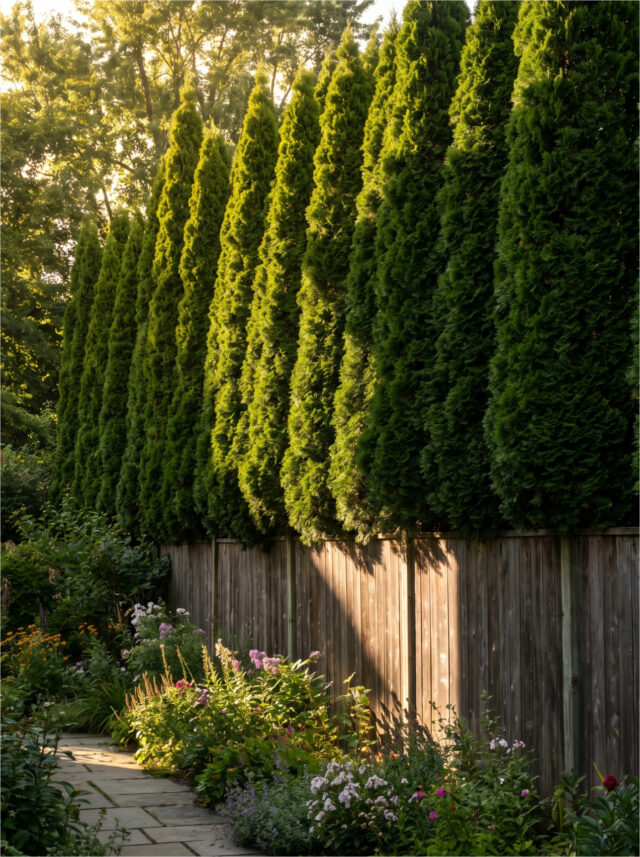
When we bought a corner plot in a gardeners’ colony on a gentle southern slope five years ago, the main attraction was the sunlight. The land was bathed in sun all day, perfect for growing tomatoes, peppers, and herbs in raised beds. Right next to it, we built a wooden terrace with a pergola, where we spent warm evenings after work. Everything was idyllic until the neighboring plot, previously owned by old Mr. Novák, was bought by a new owner—a man in his mid-forties who introduced himself as Radek.
From day one, Radek made it clear that he didn’t plan to use the garden for growing anything or working with soil. He just wanted a manicured English lawn, a pool, and above all, total privacy. Of course, nobody would object to that—if only his idea of privacy didn’t mean building an impenetrable fortress at everyone else’s expense. Just two months after moving in, he brought in dozens of saplings on a trailer—specifically, fast-growing Leyland cypresses. Instead of planting them at a reasonable distance from the property line, he dug a trench barely thirty centimeters from our shared wire fence and planted a green wall along the entire twenty-five-meter length of the fence.

Even then, I approached him with a friendly warning. I told him, “Radek, these trees grow a meter a year and reach massive sizes. If you plant them thirty centimeters from the fence, they’ll soon cross over to our side and block all the afternoon sun from our terrace and beds. Why not put up a wooden screen or plant smaller shrubs instead?” Radek just smiled condescendingly, waved his hand, and said he had it all under control, would trim them to the height of the fence regularly, and that I shouldn’t worry so much.
Those sweet words didn’t last long. Radek never touched the trees. In the rich soil, the Leylands shot up at an incredible rate. Within two years, the small shrubs had become a solid, four-meter-high and two-meter-wide dark green wall. The branches started to aggressively grow through our fence, which began to bend and deform under their weight.
The impact on our garden was devastating. The green wall stood exactly on the western side of our plot. From two o’clock in the afternoon, half of our land was plunged into heavy, cold, and damp shade. The vegetable beds, which once produced dozens of kilos of sweet tomatoes, began to struggle. The soil under the trees stayed constantly wet, moss grew, and the plants withered and became moldy without afternoon sun. On top of that, the terrace: instead of enjoying pleasant evenings in the sun, we sat in gloom as if in a deep forest, and in summer we had to put on sweatshirts by six in the evening because the chill from the shade was unbearable. Not to mention that in autumn, piles of acidic needles fell on our manicured lawn, burning yellow patches into the grass.

When I caught Radek by the pool the month before last and firmly asked him to cut the trees down to a maximum height of two meters and trim the branches crossing our fence, I ran into sheer arrogance. He stood there with his hands in his pockets and dryly told me, “Neighbor, the trees are on my land, I’m protecting my privacy from your eyes, and I have no plans to trim anything. I like the tall wall. And if your beds are in the shade, just buy your tomatoes at the supermarket—they have plenty of sun there.”
This blunt disregard was the last straw. I realized that basic human decency was no longer an option. I sat down at my computer and studied the civil code, specifically the provisions on neighbor rights and nuisance by shade. The law is clear: the owner of a property must not shade a neighboring property beyond what is reasonable, so as to substantially limit its normal use, and for trees exceeding three meters in height, the legal minimum distance from the property line is three meters.
I documented the situation in detail. At noon and in the evening, I took time-lapse photos of the shade falling on our beds and terrace, measured the bent fence, and counted the length of overhanging branches. Then I went to a lawyer and had an official pre-lawsuit notice drafted. In the registered letter, Radek was clearly instructed: either he radically cuts back the trees to the legal height and removes the branches encroaching on our fence within thirty days, or we would file a neighbor lawsuit at the district court, including a claim for damages for the destroyed fence and an expert assessment.
When Radek received the letter stamped by the law office and realized that losing in court would cost him tens of thousands of crowns in legal fees and assessments, his cocky smile disappeared for good. The following weekend, he borrowed a chainsaw and, with a sour face, cut the entire wall down to the prescribed two meters and completely removed the branches reaching our side.
After two years of darkness, sunlight finally returned to our terrace and beds. It was a clear lesson for me: with inconsiderate people who confuse privacy with terrorizing neighbors, there’s no point wasting time pleading. When it comes to rudeness and arrogance in neighbor relations, only precise knowledge of the law, a letter from a lawyer, and an uncompromising approach will work.