


Among people who know at least a little about cars, there’s one unwritten, time-tested rule: never help friends or family buy a used car. No matter how much effort you put in—checking paint thickness, running diagnostics, listening to the engine—a used car is still just a collection of thousands of worn parts. As soon as anything goes wrong, all the blame doesn’t fall on the dealership or the previous owner, but on the person who stood next to you and said it looked good at that moment. I used to take this warning lightly, until I got burned by my friend Tomáš.
Tomáš and I had known each other for over ten years. Last spring, when he decided to replace his aging first-generation Fabia with a newer family diesel wagon and had a budget of around two hundred thousand crowns, he turned to me. He knew I was into cars, had a diagnostic cable, a paint thickness gauge, and did basic mechanical work on my own cars. Tomáš didn’t understand cars at all—for him, it just needed a big trunk, low fuel consumption, and a dashboard that lit up.

On Saturday morning, I started my car, packed my tool bag, and we set off for a full day touring dealerships in the region. I spent eight hours with him, drove hundreds of kilometers, and checked four different cars. The first two were disguised traps—badly crashed and with rolled-back mileage, the third had a ruined dual-mass flywheel. Only at the fourth dealership did we find a well-kept third-generation Octavia with a 2.0 TDI engine.
The car had a genuine 210,000 kilometers, a documented service book, original paint except for one fender repainted after a parking scrape, and a clean error code report. On the lift, the chassis was solid, no oil leaks anywhere, the particulate filter had normal soot levels, and the engine ran quietly and smoothly.
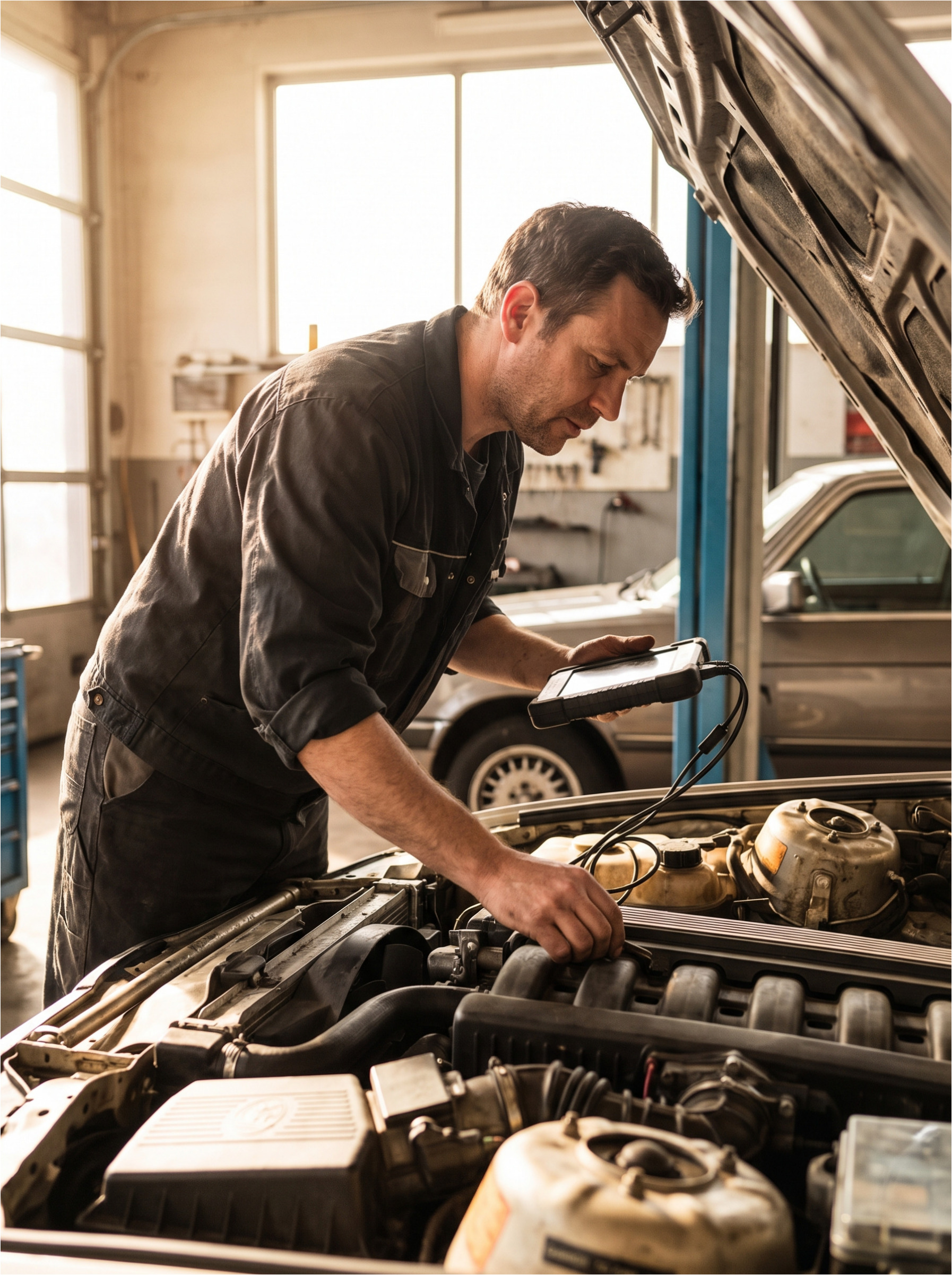
Tomáš was thrilled and wanted to sign for the car immediately. But before that, I warned him firmly in the dealership office: “Tom, this car looks mechanically and visually very healthy, and for the money, it’s a solid buy. But remember, it’s got over two hundred thousand kilometers. It’s a modern common-rail diesel. At any time, an injector, turbo, or alternator could fail. After buying, you need to immediately do the timing belt, change the oil, and keep about thirty thousand aside as a financial cushion for regular maintenance.” Tomáš nodded, thanked me, patted me on the back, and swore he understood everything. He didn’t even offer to pay for my fuel for the whole day, but I let it go—I took it as a friendly favor.
For the next half year, everything was sunshine and roses. Tomáš registered the car, happily drove it to work and on a family holiday to Croatia, and at our regular beers he praised how well it pulled and how it did five liters per hundred. But his promises of immediate maintenance quickly faded. Instead of using quality oil and shortening the interval to ten thousand kilometers, he kept driving, didn’t bother with the timing belt, and apparently revved the engine cold, just like he was used to with his old petrol car.
The turning point came in November, about seven months after the purchase, when he’d put another fifteen thousand kilometers on the car. On the highway, while overtaking, the engine lost power, there was a loud whistling sound, and blue-white smoke poured from the exhaust. Classic turbo bearing failure. A wear-and-tear issue that can happen to any turbocharged diesel with over two hundred thousand kilometers at any moment.
When Tomáš texted me from the tow truck that his car wouldn’t run, I called him right away. I expected a normal conversation about which garage to take it to and where to find a good reconditioned turbo at a reasonable price. Instead, I was greeted by a cold, hostile tone full of resentment: “Thanks a lot, genius. The garage told me fixing the turbo and cleaning the intake and intercooler will cost twenty-five thousand. You made me spend two hundred thousand on a wreck. You checked it and said it was in perfect shape! You must have known the turbo was on its last legs, and you still talked me into it.”

I was stunned. I tried to calmly explain that no one can see inside a turbo bearing without taking it apart, that diagnostics won’t show shaft wear, and that on the day of purchase I literally told him to keep a reserve for exactly these situations. It was like talking to a wall. Tomáš started yelling hysterically that I’d ruined his family budget and cheated him.
Then he hung up. From that moment, he cut off all contact with me.
When I ran into him at the store a week later, he turned away to the shelves and pretended not to see me. He didn’t reply to messages, didn’t answer calls, and soon I heard from our mutual football friends that he was telling wild stories at the pub—how I was in cahoots with the dealership, took a secret commission, and set him up with a car that blew its engine just months later. Ten years of friendship and dozens of shared memories erased in a second, just because he couldn’t accept that a used car needs maintenance and money.
It was a huge, final slap in the face for me. I realized that being a free technical advisor for people is the quickest way to lose both friends and a clear conscience. Anyone who wants to save money by skipping a professional inspection and relies on a friend’s help will never blame themselves or the age of the machine if anything goes wrong. They’ll always find a scapegoat in the person who selflessly helped in their free time. Since then, whenever someone asks me to check a car, I answer with one sentence: “I’m happy to grab a coffee with you, but if you’re buying a car, pay for an authorized service inspection or an independent technician with a stamp.” It’s just not worth losing your own peace of mind.