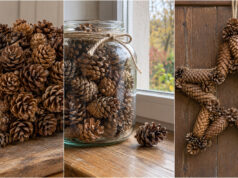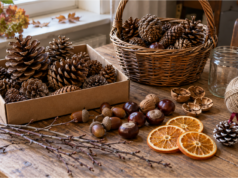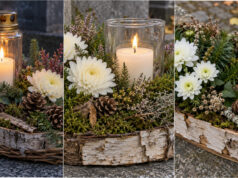

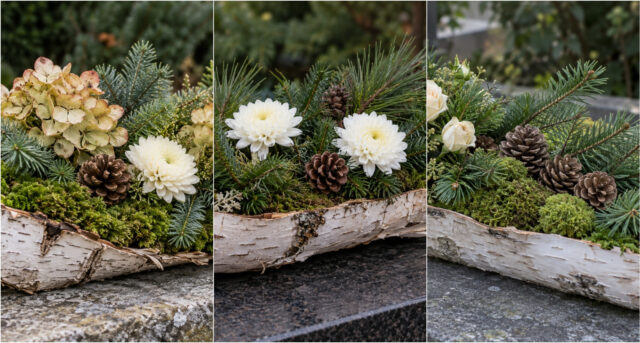
A natural All Souls’ Day decoration made from birch bark looks subtle, tasteful, and blends beautifully into the autumn cemetery setting. Simply fill an elongated birch bark base with moss, conifer branches, and cones, then add a few flowers of your choice.
What You’ll Need
- larger pieces of birch bark
- fresh or dried moss
- conifer branches
- cones of various sizes
- fresh or dried flowers
- depending on your chosen style: heather, small twigs, or dried flower heads
When gathering natural materials, be considerate. Do not peel bark from living trees—use only loose or already detached pieces.
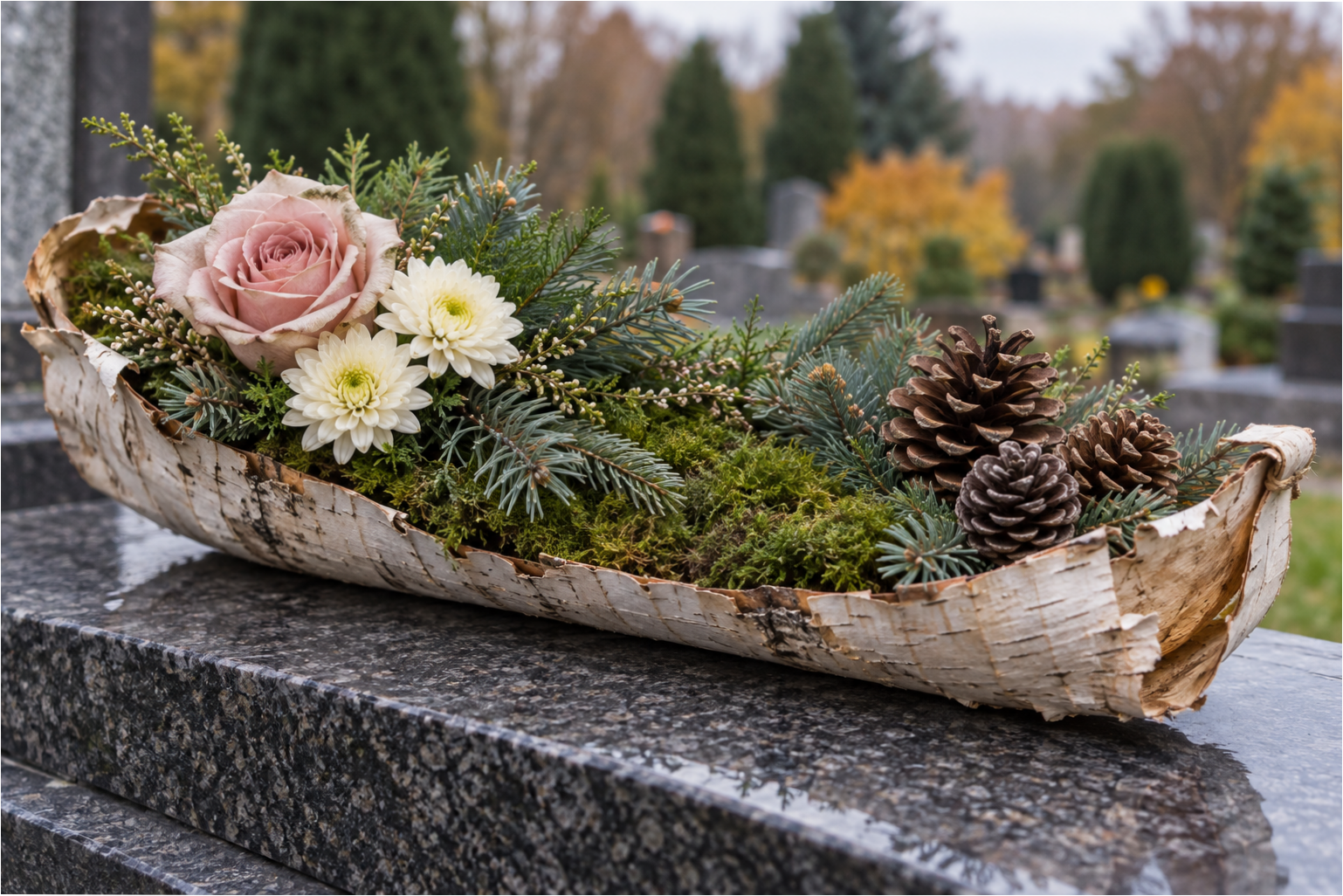
1. Shaping the natural base: Choose an elongated piece of birch bark with naturally raised edges, forming a shallow boat shape. Line the inside with a continuous layer of moss and arrange spruce branches along the sides. The first example is complemented by white flowers, cones, and delicate light twigs.
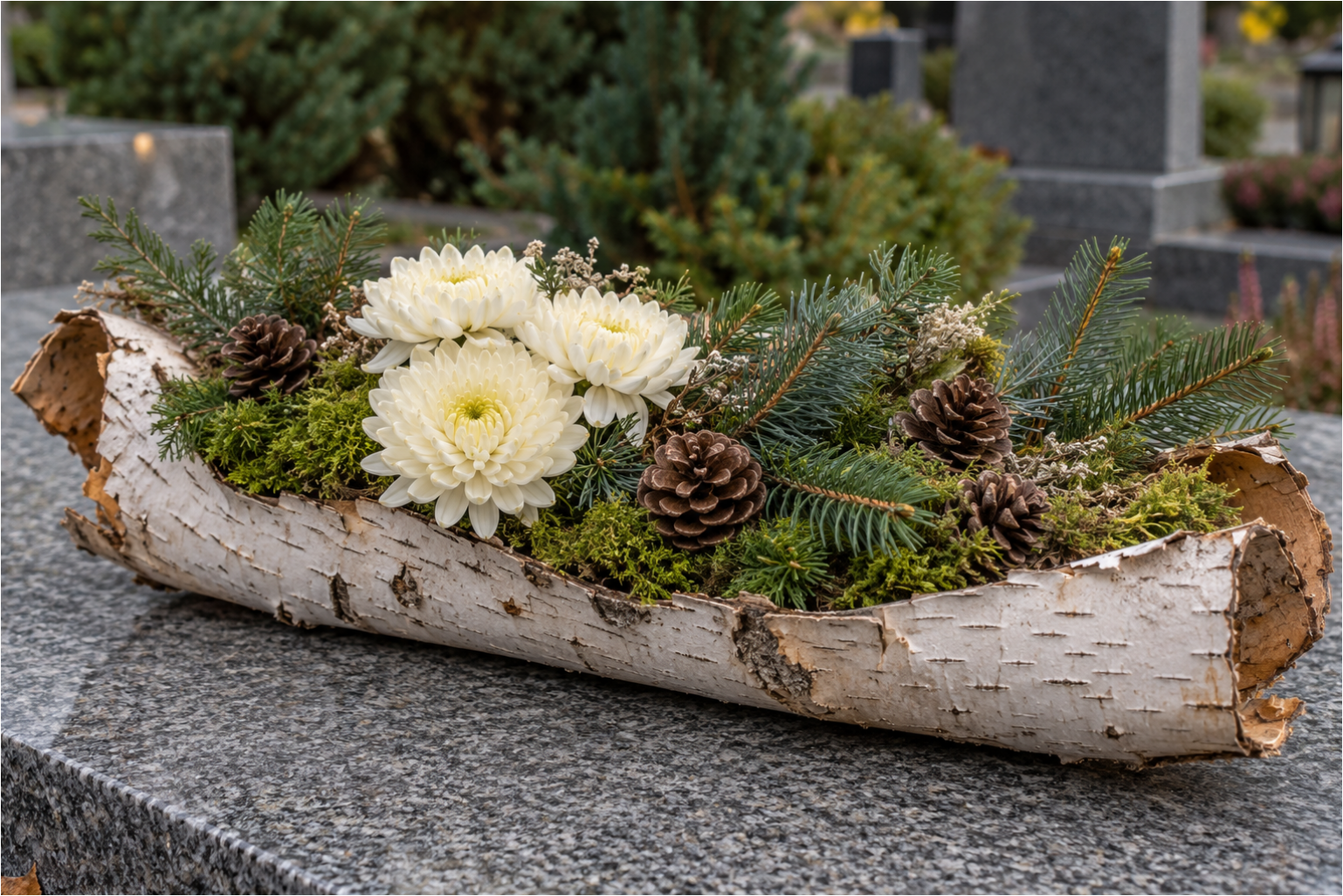
2. Creating a focal point: The main flowers don’t have to be centered. In the photo, roses and smaller light flowers are grouped on one side, while cones balance the other side. This irregular arrangement gives the decoration a more natural look.
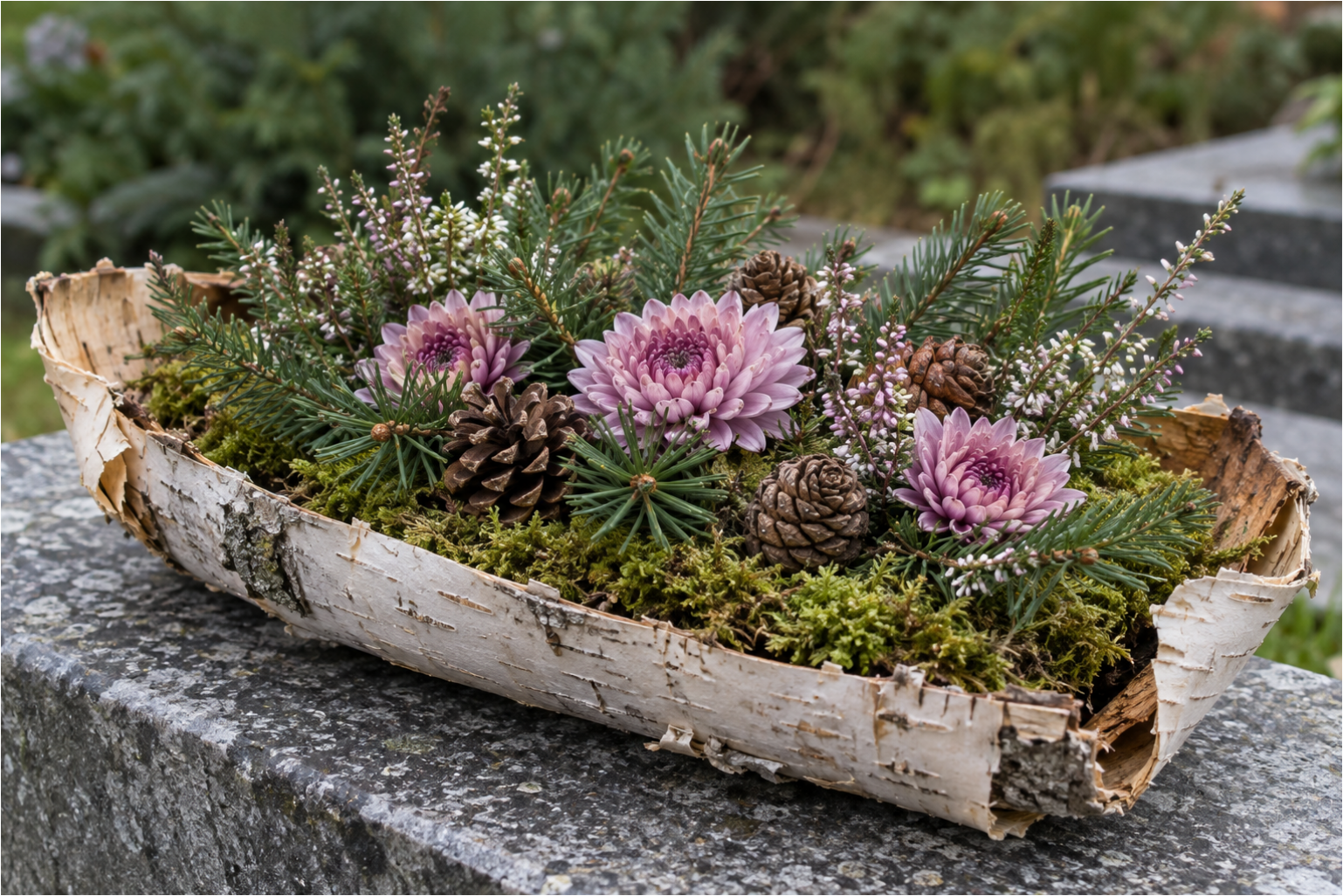
3. Adding airy twigs: Insert delicate twigs with tiny blossoms among the needles. Distribute purple flowers in several spots and link them with cones. Leave some moss visible to preserve the natural character of the base.
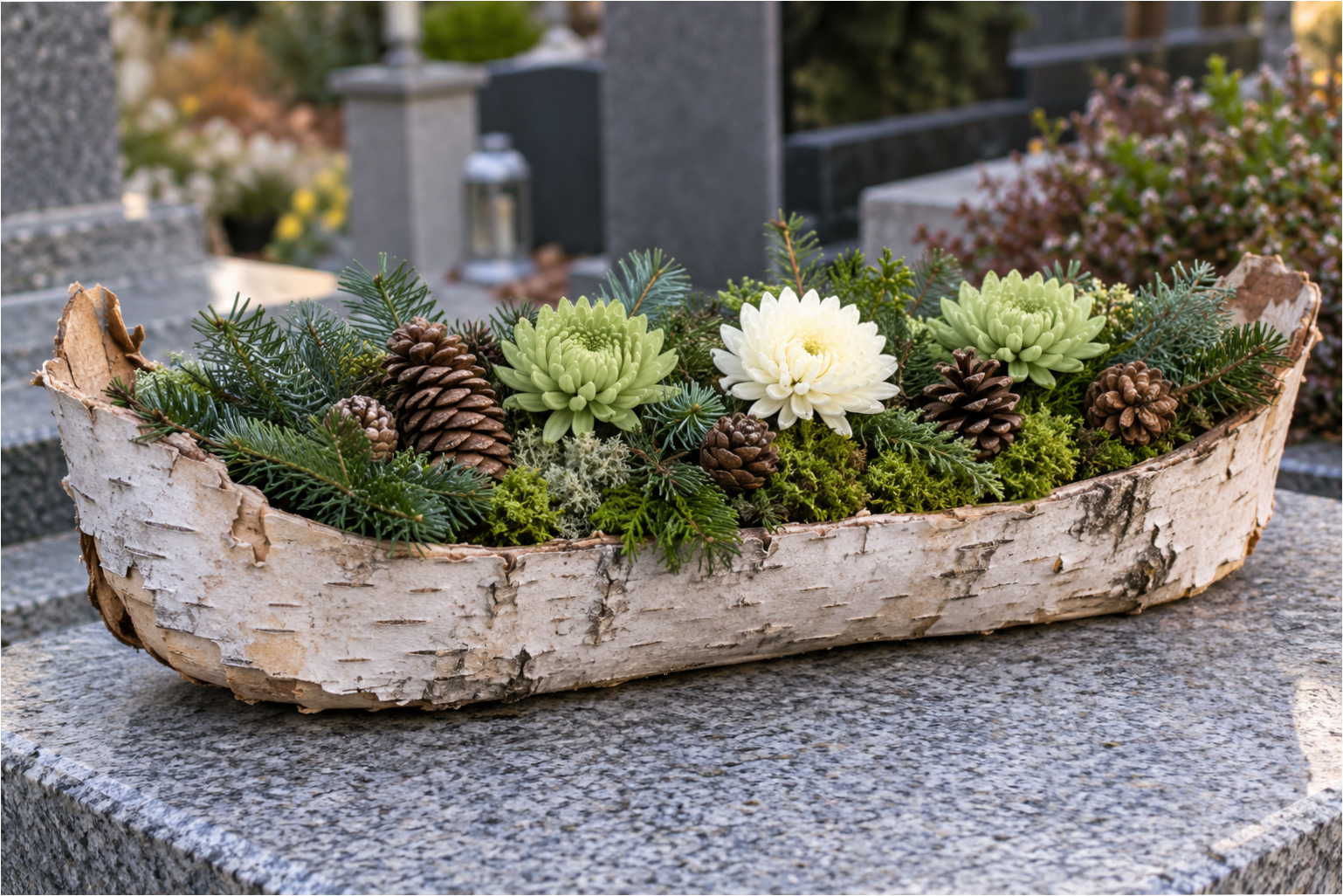
4. Varying colors and heights: Place green and white flowers in a single line, but alternate their heights slightly. Fill the spaces between them with smaller cones and short conifer branches. The result will look neat without being overly uniform.
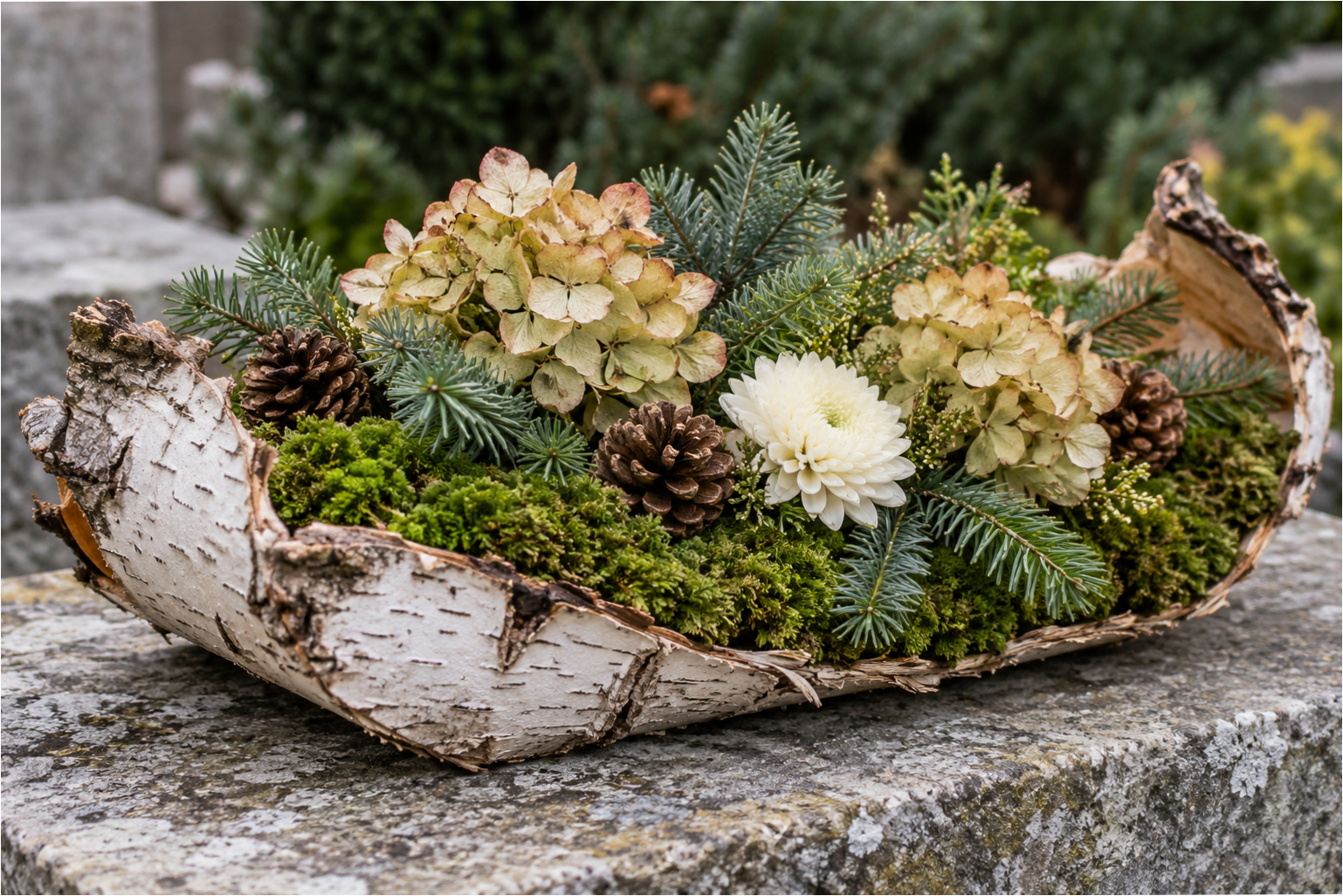
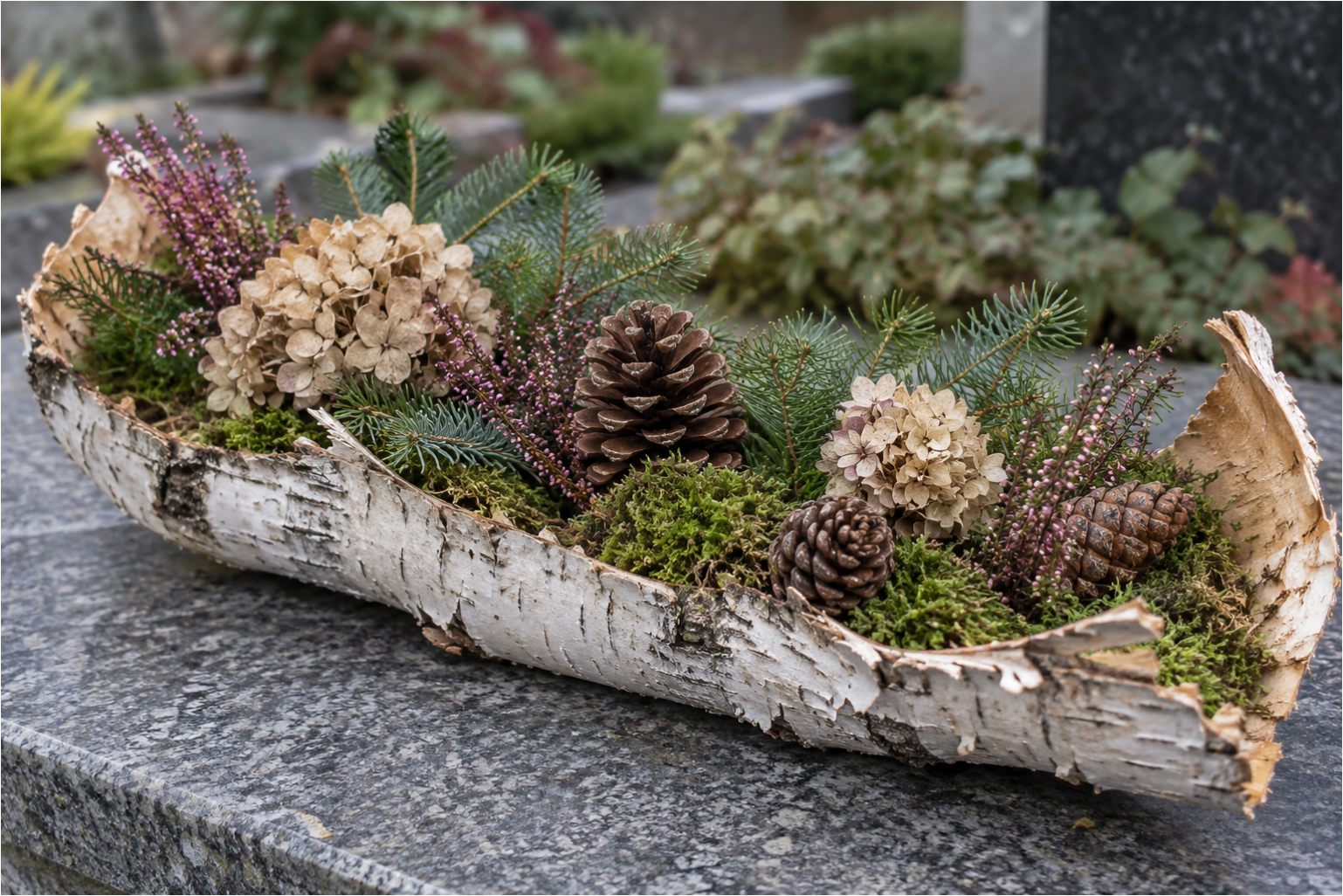
5. Using dried flower heads: You can also incorporate light-colored dried flower heads into the moss base. In the photo, two taller elements create a focal point, complemented by a white flower, cones, and conifer branches.
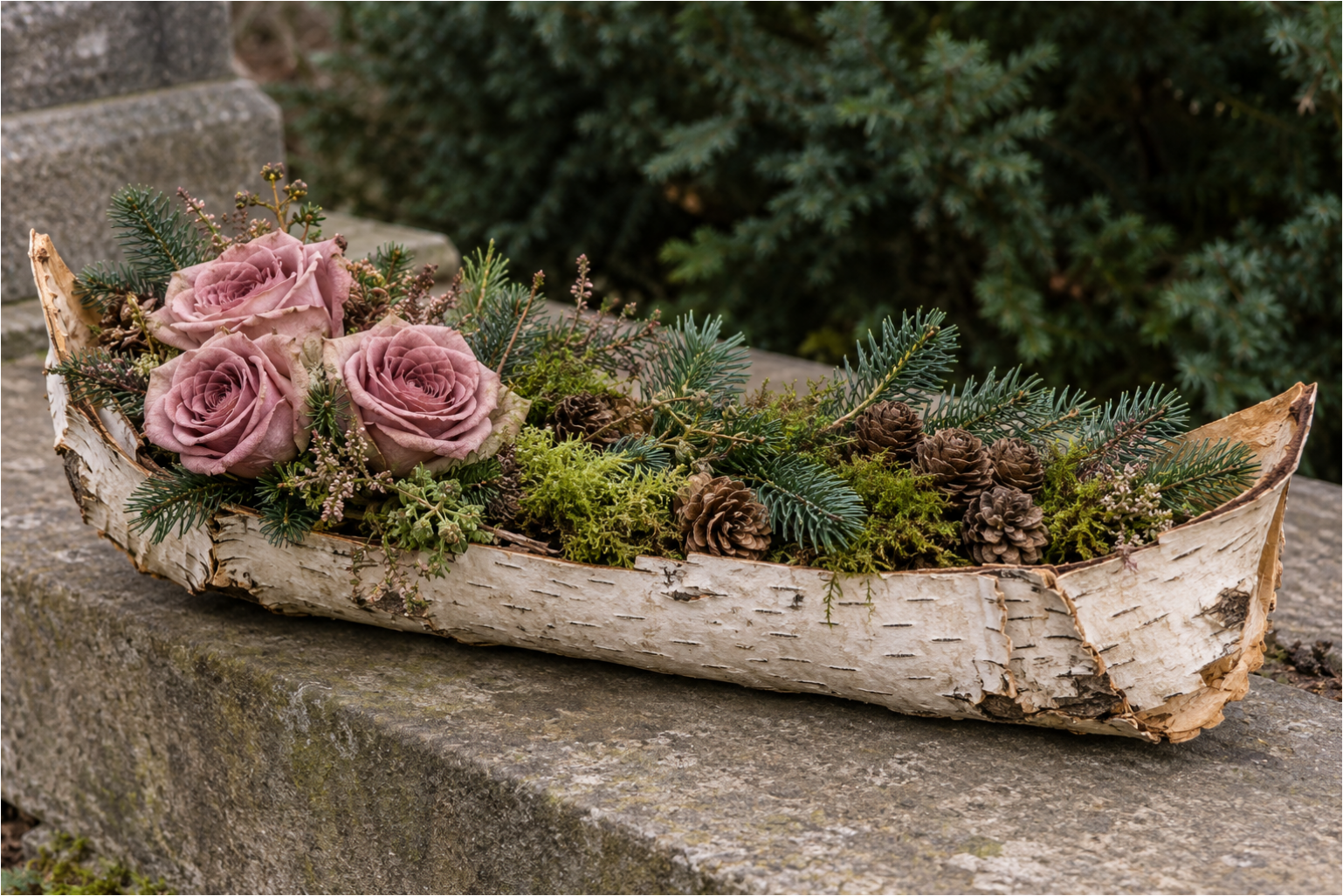
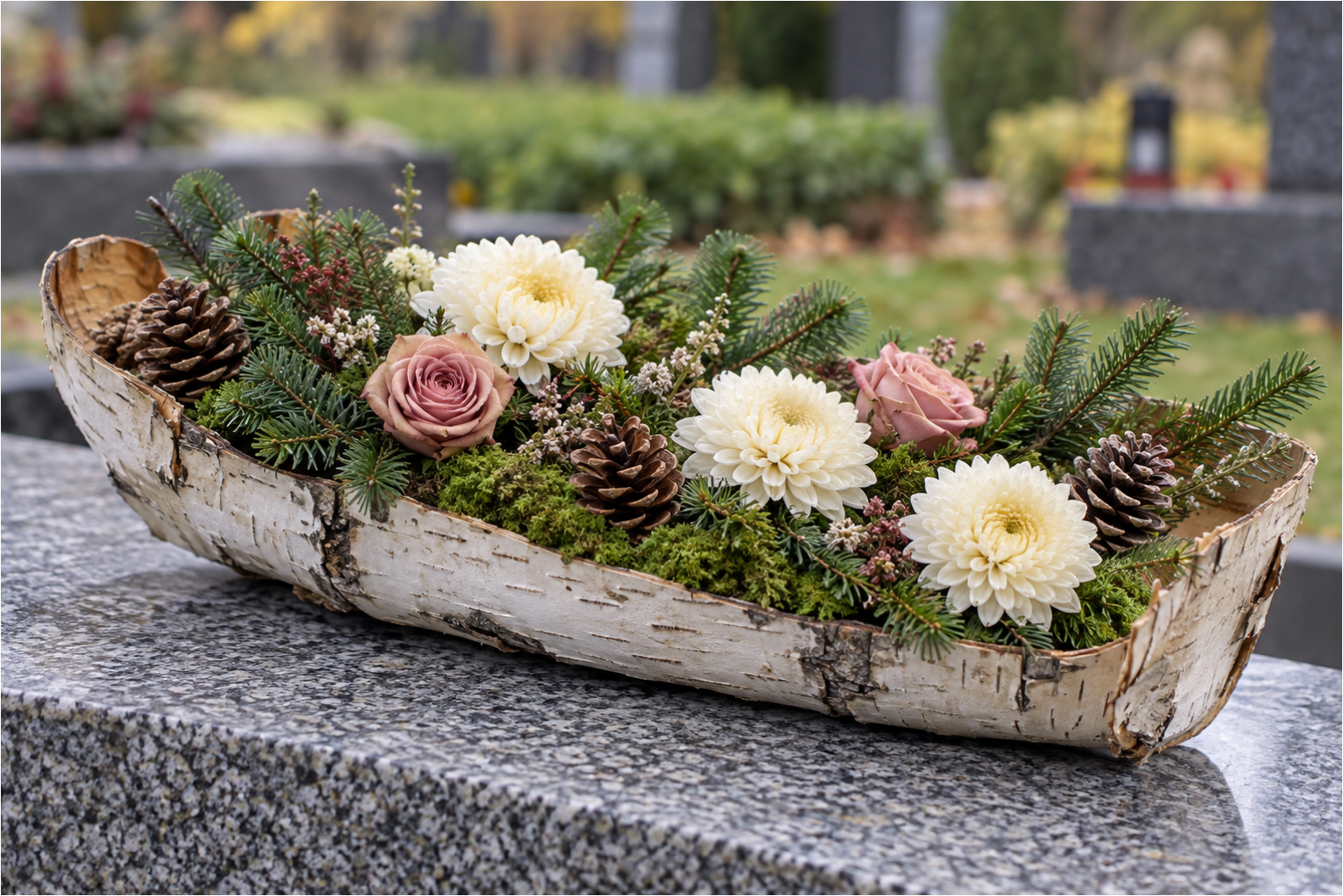
6. Grouping roses: Cluster three muted dusty pink roses at one end of the bark. Keep the rest of the decoration calmer, filling it with moss, green branches, and a few cones. This layout works well for a long, narrow base.
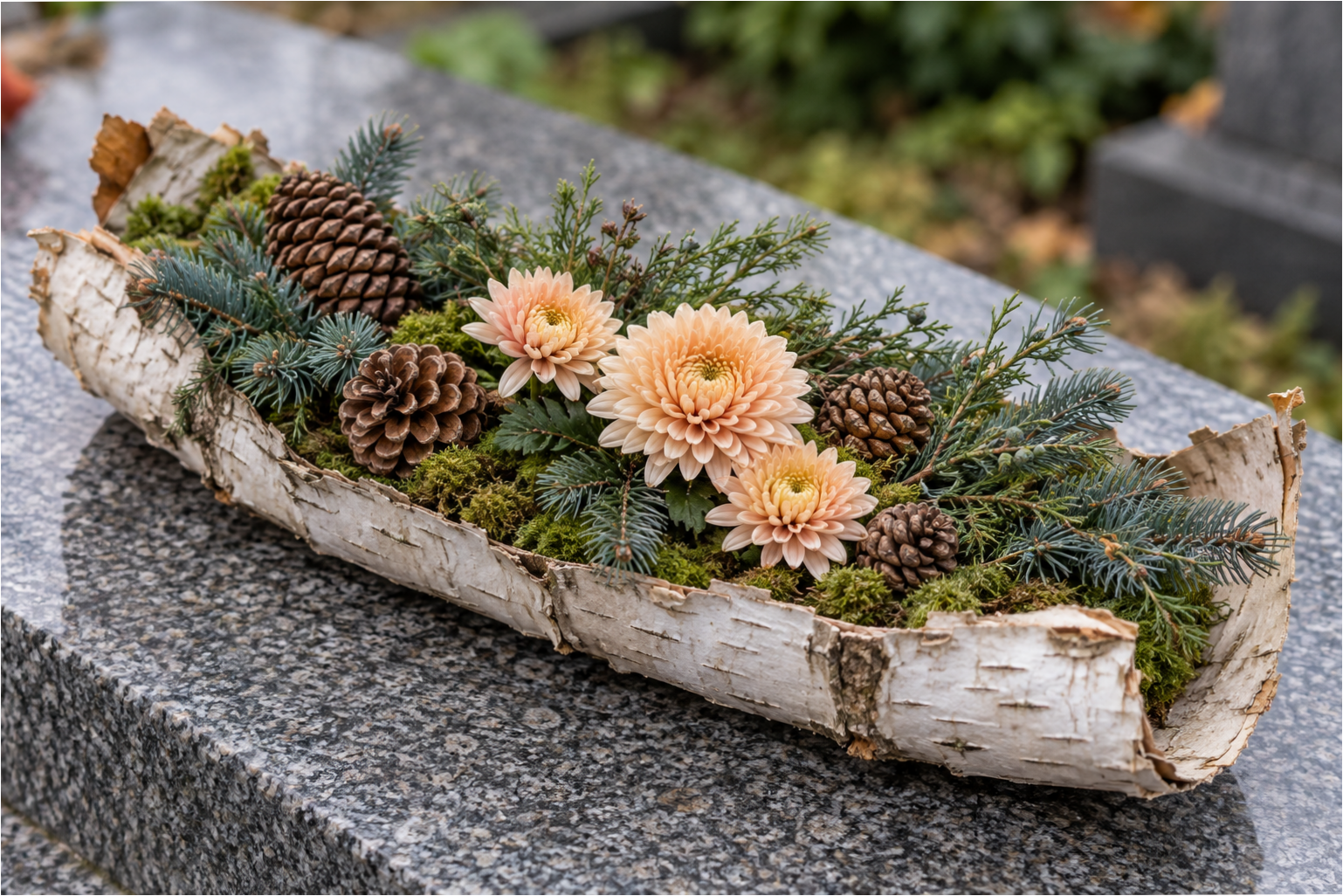
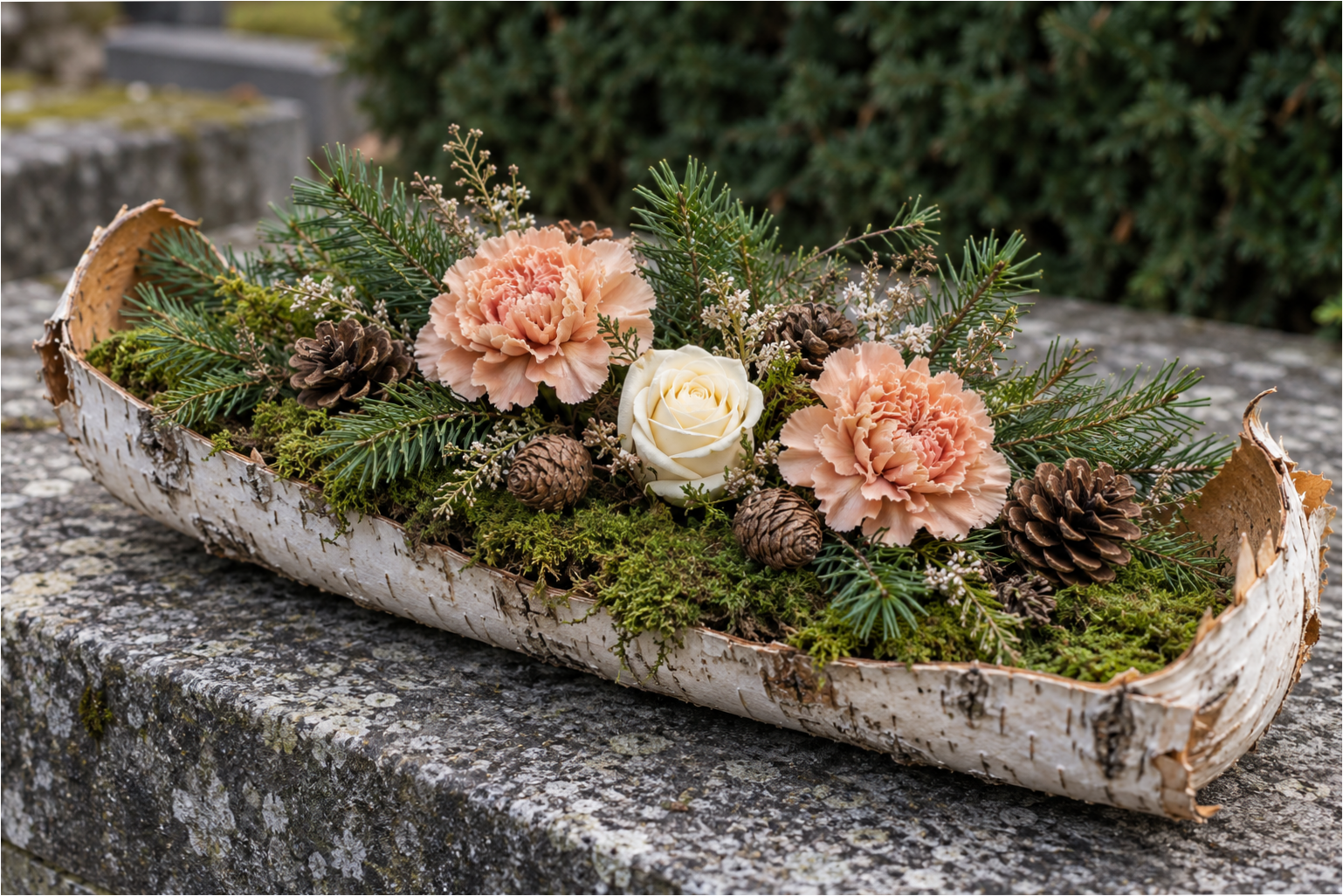
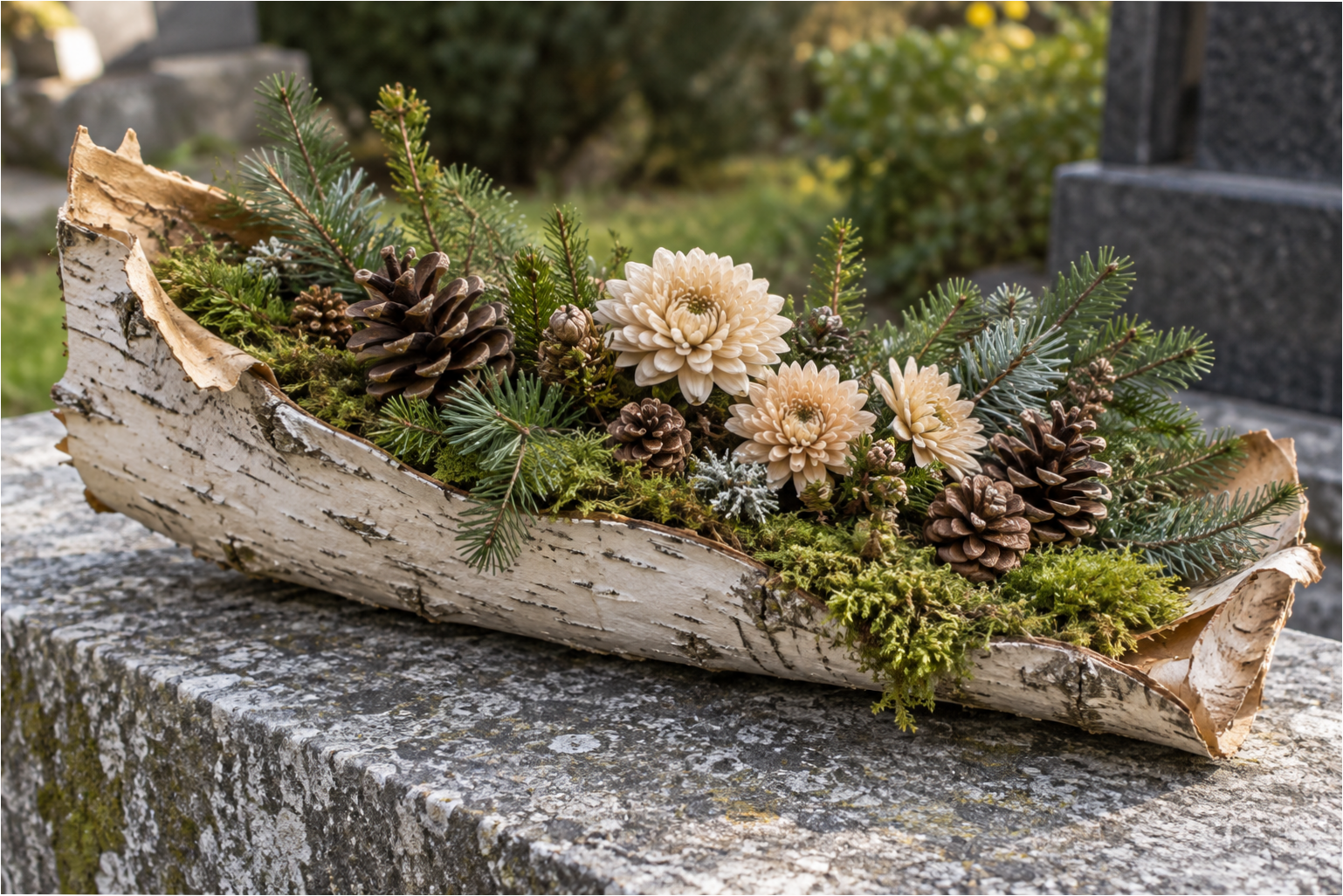
7. Working with warm tones: Arrange apricot flowers along the center and surround them with blue-green needles. Place larger cones toward the back, and use smaller ones to fill gaps near the flowers. The warm color contrasts nicely with the white bark.
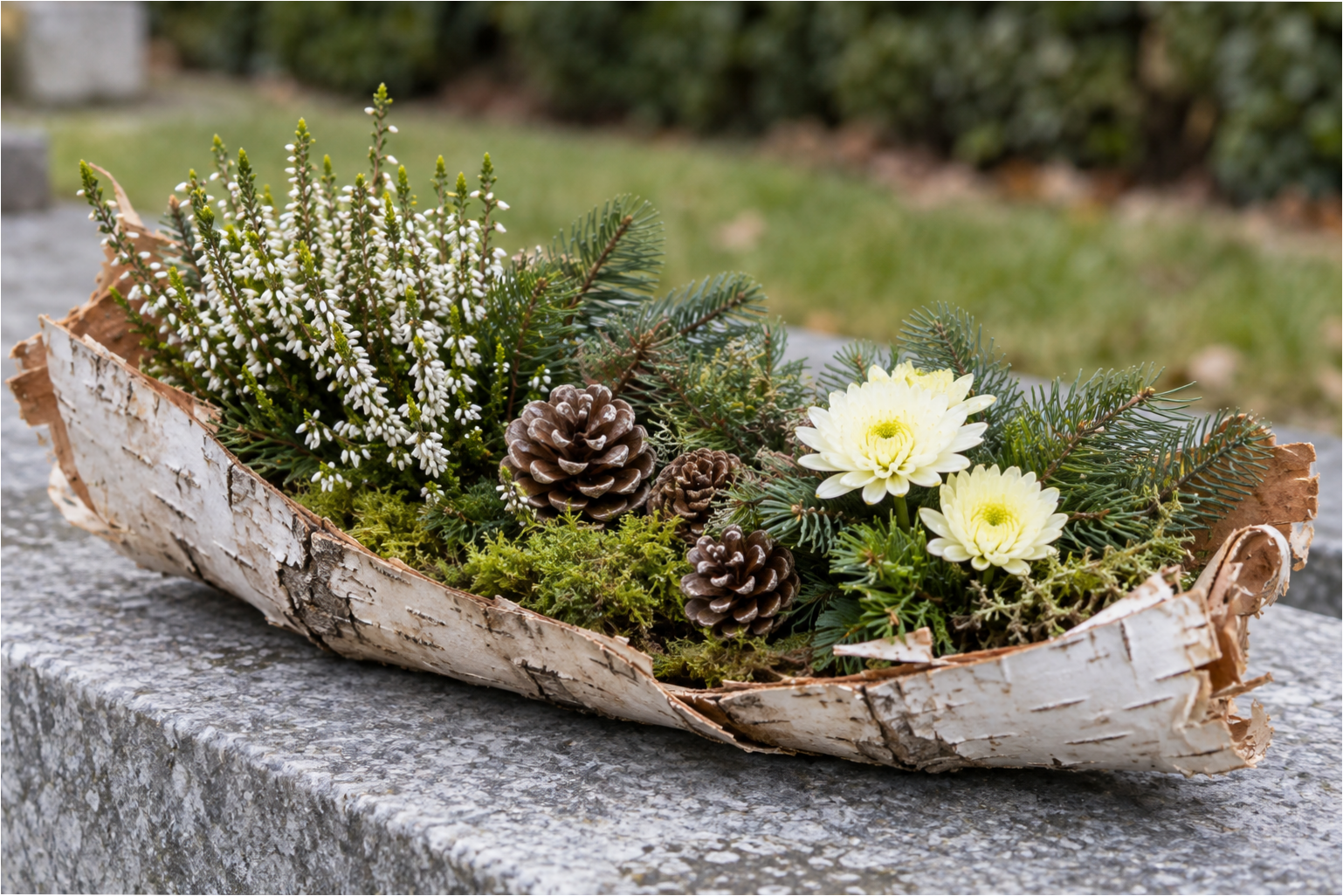
8. Adding heather: Fill one end of the decoration with a compact clump of white-blooming heather. Place two light flowers on the other side, and insert several cones between the two sections. Moss ties all the elements together into a cohesive whole.
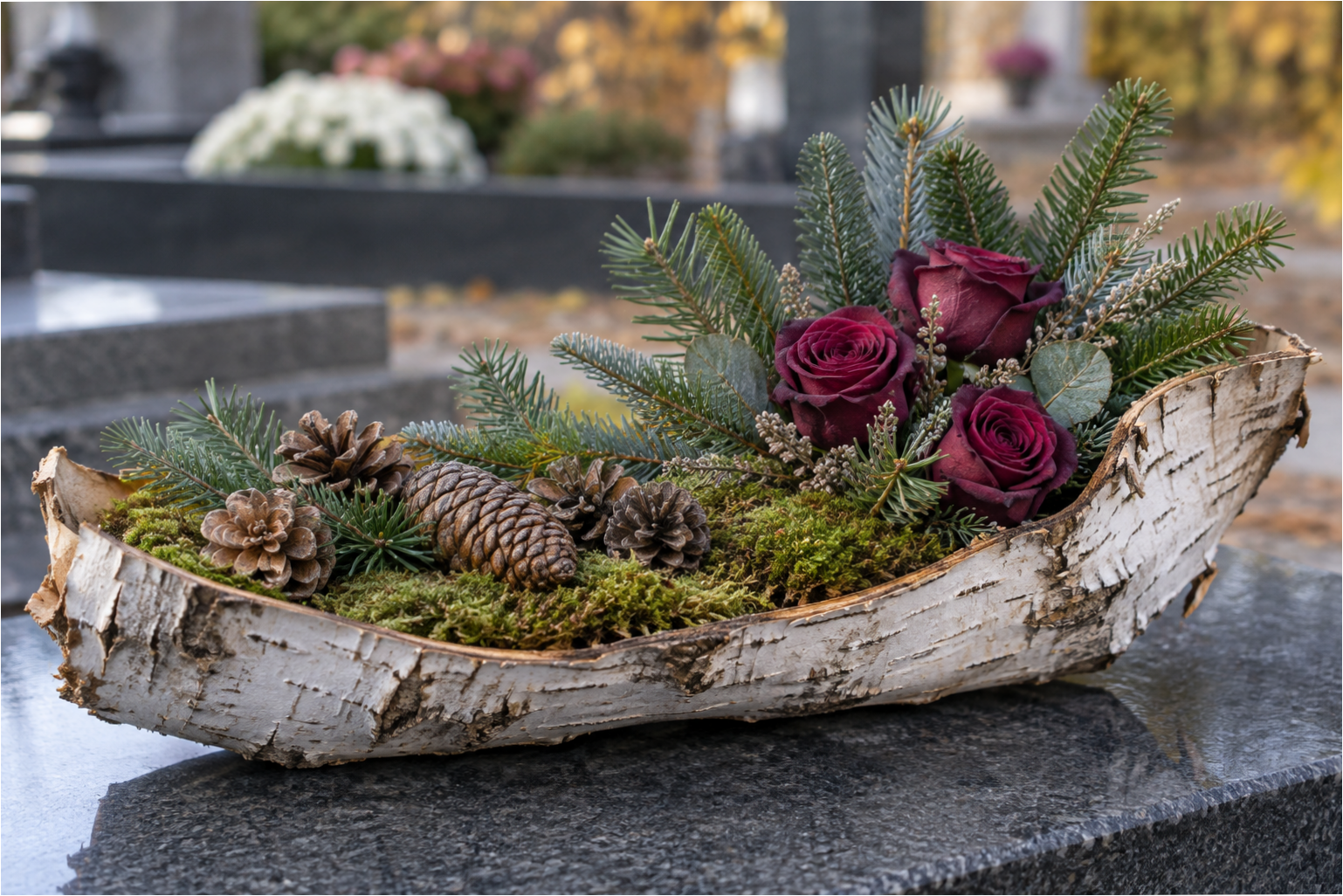
9. Creating a higher back line: Raise longer conifer branches behind the flowers to form a green backdrop. Dark roses will stand out, while the front can remain lower and covered with moss and cones.
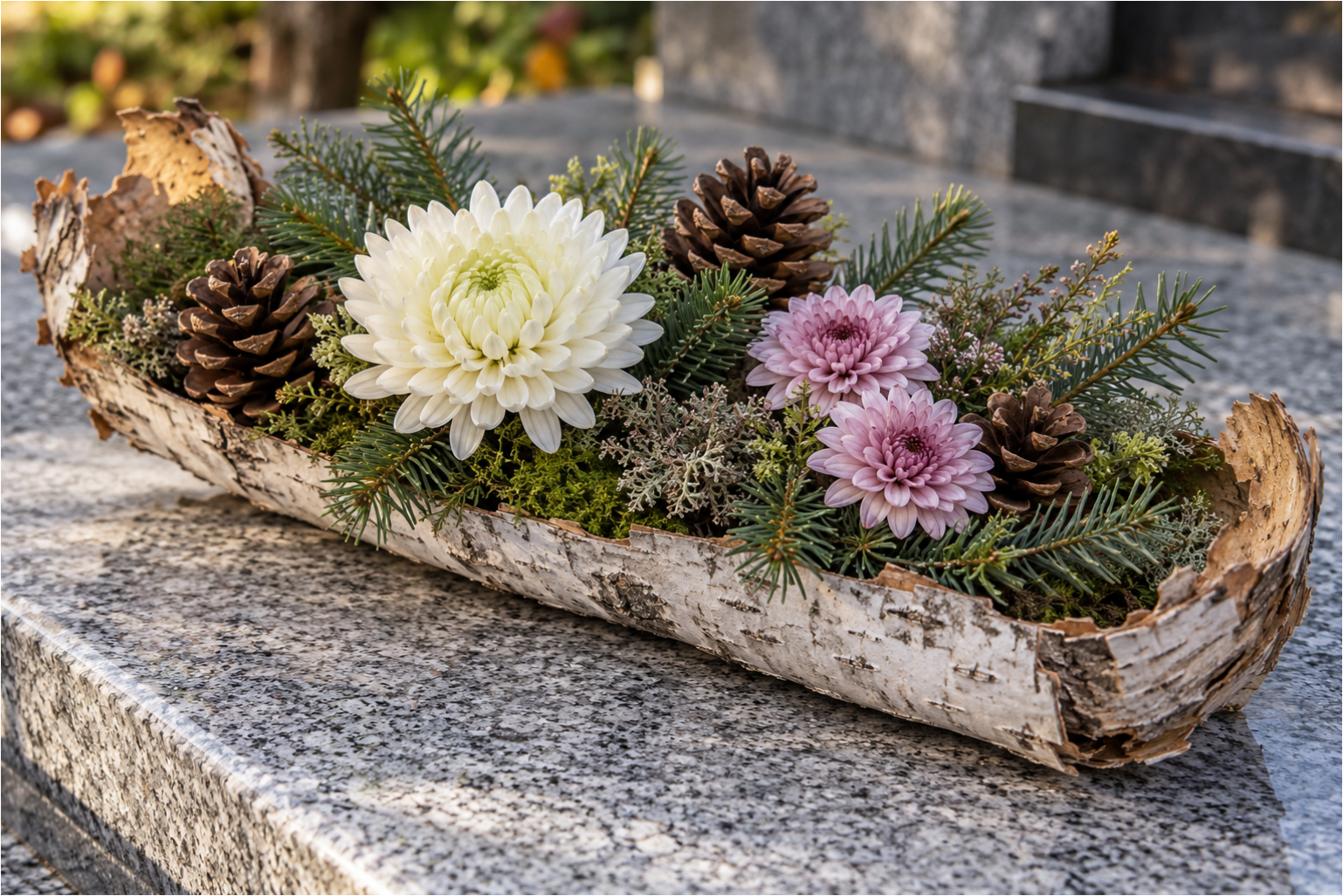
10. Combining flowers of different sizes: Use one large white flower as the main focal point and complement it with two smaller purple flowers. Distribute cones on both sides for a visually balanced composition.
11. Softening with carnations and roses: Place apricot carnations and a light rose in an irregular rhythm. Insert smaller cones, delicate twigs, and needles between the flowers. Make sure each stem is pushed deep enough into the moss layer to stay in place.
12. Creating a purely autumnal version: If you don’t want to use fresh flowers, opt for dried flower heads and heather. Brown cones, muted plant tones, and green moss create a restrained decoration suitable for a natural gravestone.
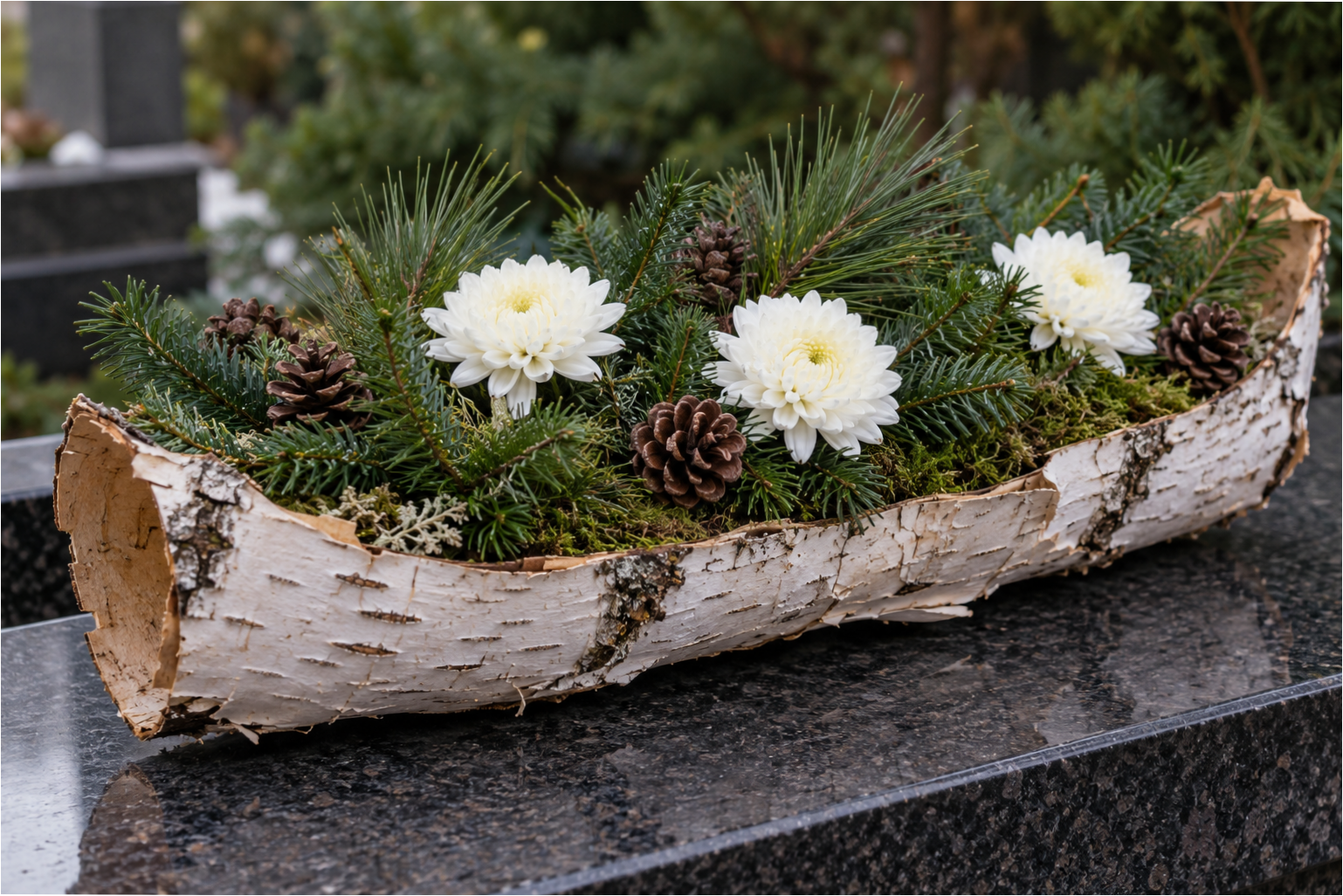
13. Arranging white flowers: Space three white flowers among upright conifer branches. Add cones to the empty spots and cover the entire surface with moss. A few taller green branches will give the decoration the necessary volume.
14. Keeping open space: You don’t need to fill the base with lots of flowers. In this version, light roses are grouped on the left, cones in the center, and the right side is mainly moss and needles. This composition feels calm.
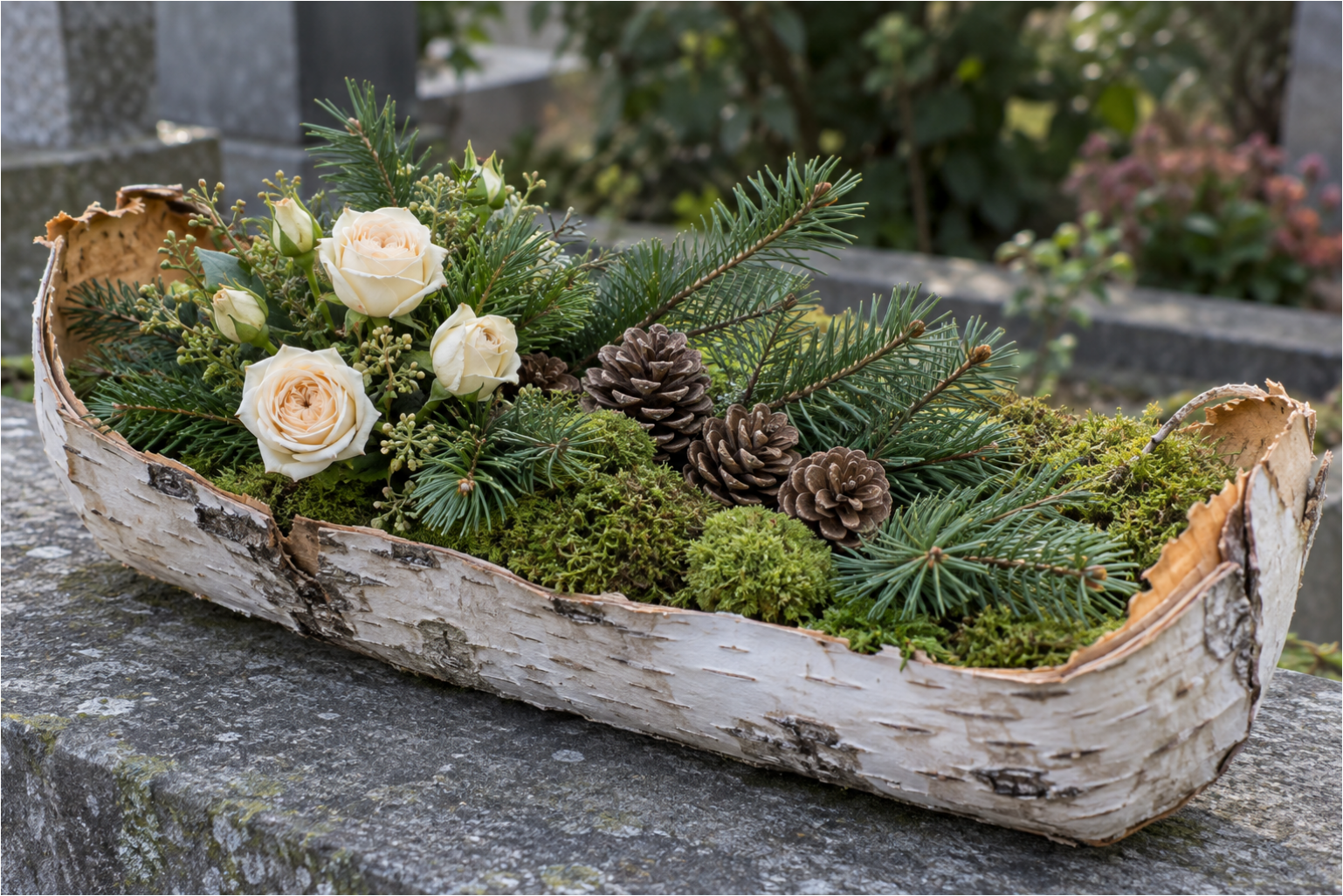
15. Connecting muted colors: Pair a dusty pink rose with light green flowers and small pale twigs. Place cones in the middle and front. All elements should partially overlap the needles, but not cover the birch bark.
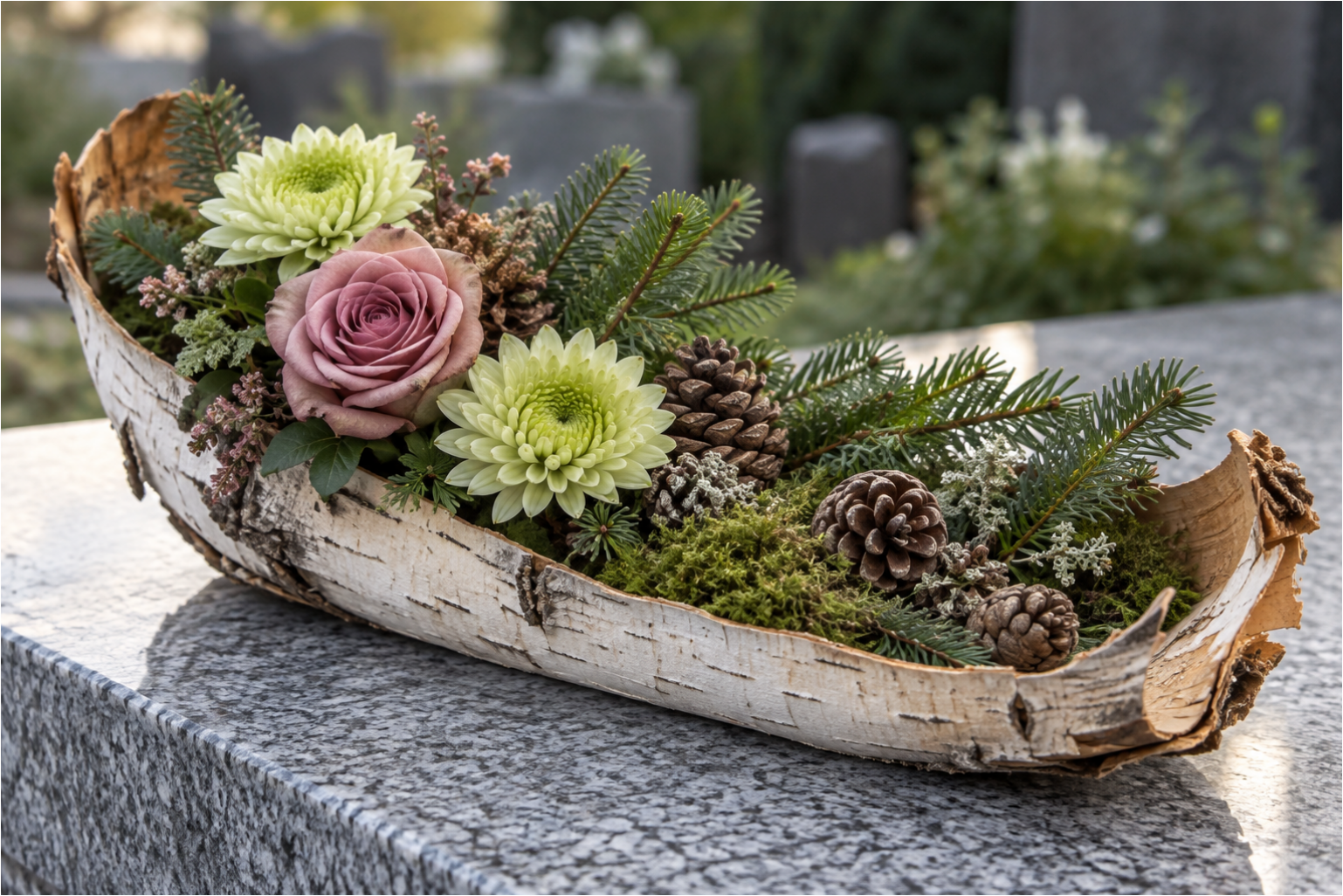
16. Adding delicate heather: Arrange apricot flowers among several clumps of purple heather. Place larger cones at the edges and smaller ones between the flowers. This version is richer, yet still looks natural.
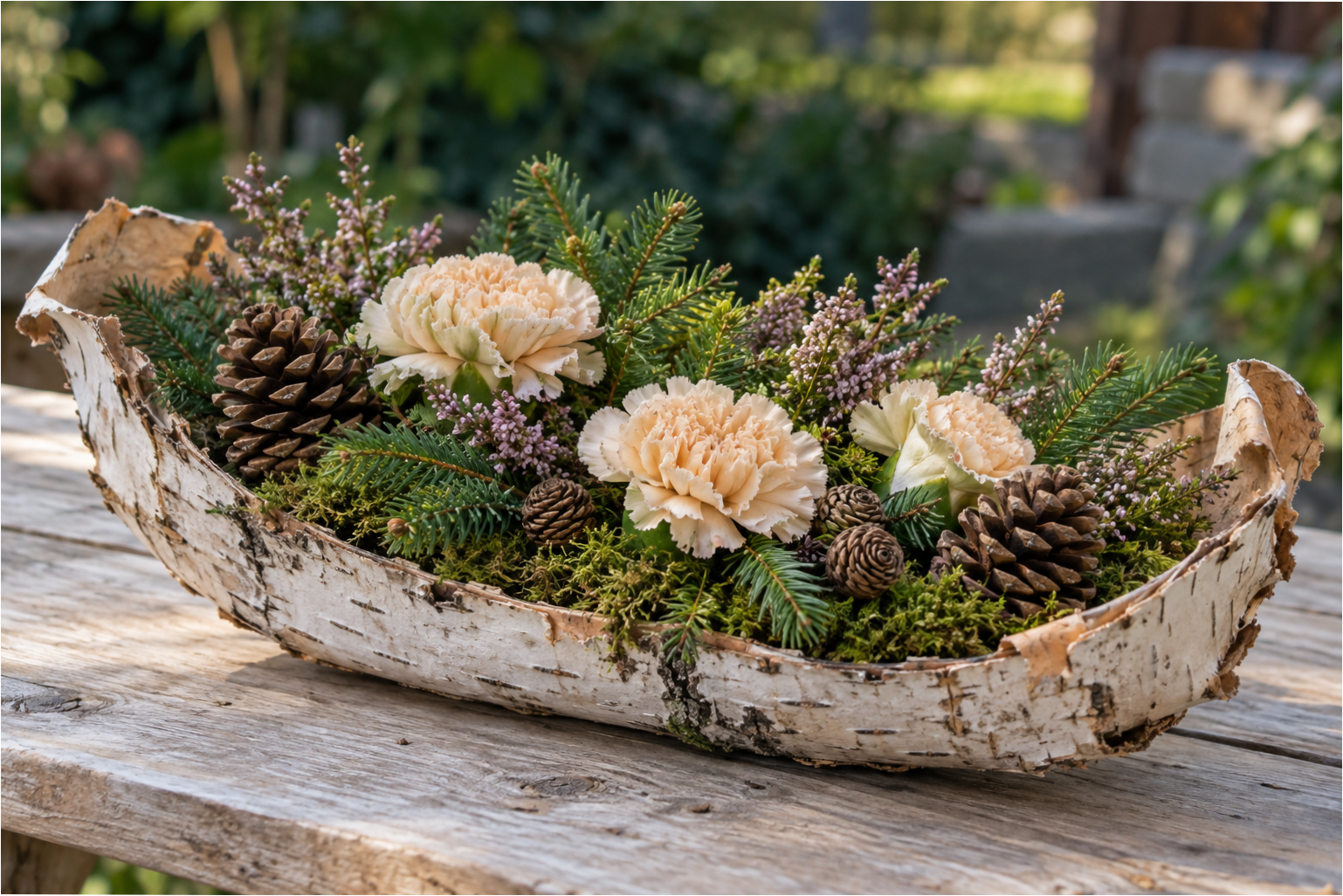
17. Using dried strawflowers: For a longer-lasting decoration, use light dried flowers. Group them together, add cones, and surround with dense green branches. Moss will cover empty spots and soften the transitions.
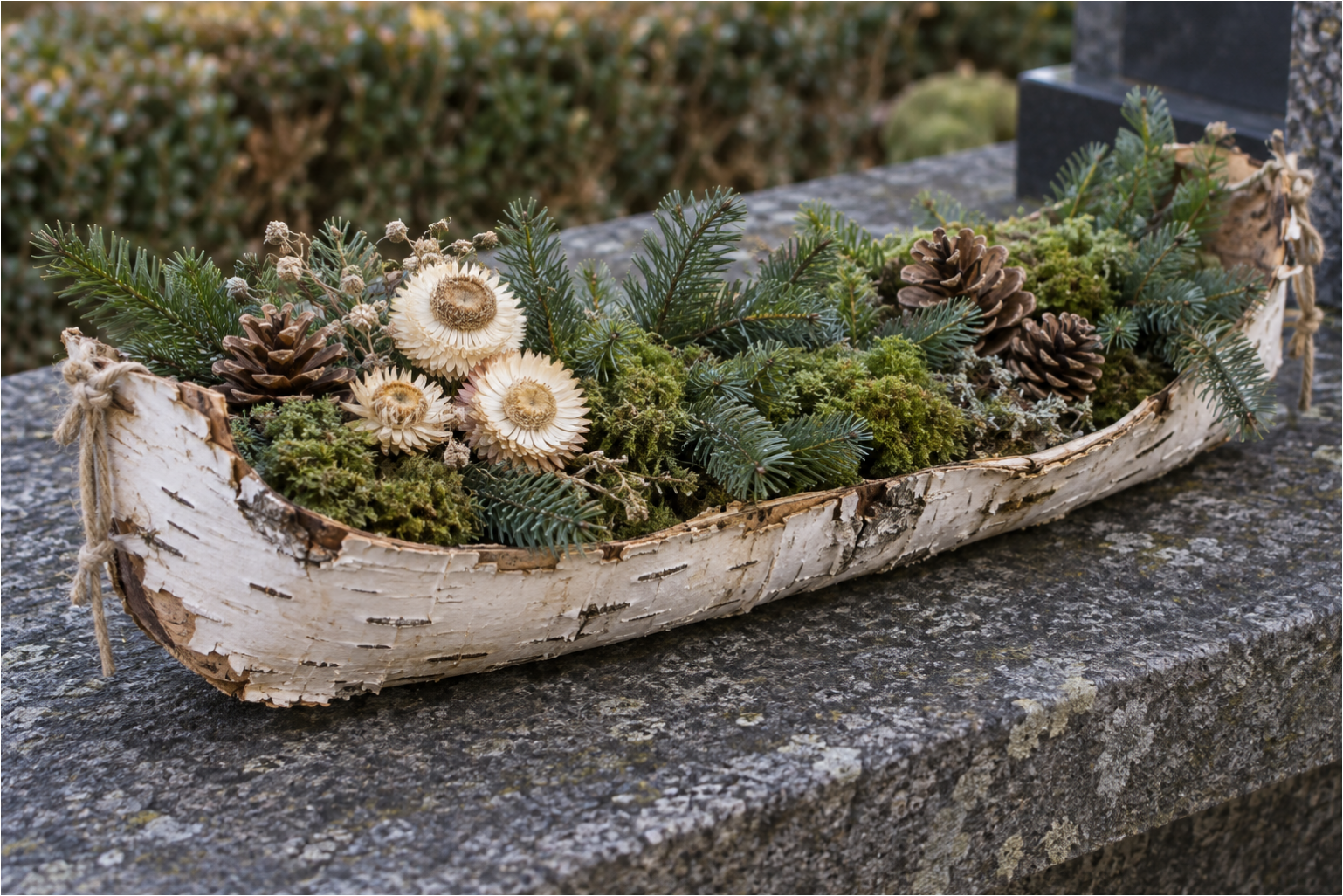
18. Dividing the decoration into color zones: Place a purple flower on one side and light roses on the other. Cones, needles, and delicate blooming twigs connect the center. The asymmetry gives the arrangement a natural yet elegant look.
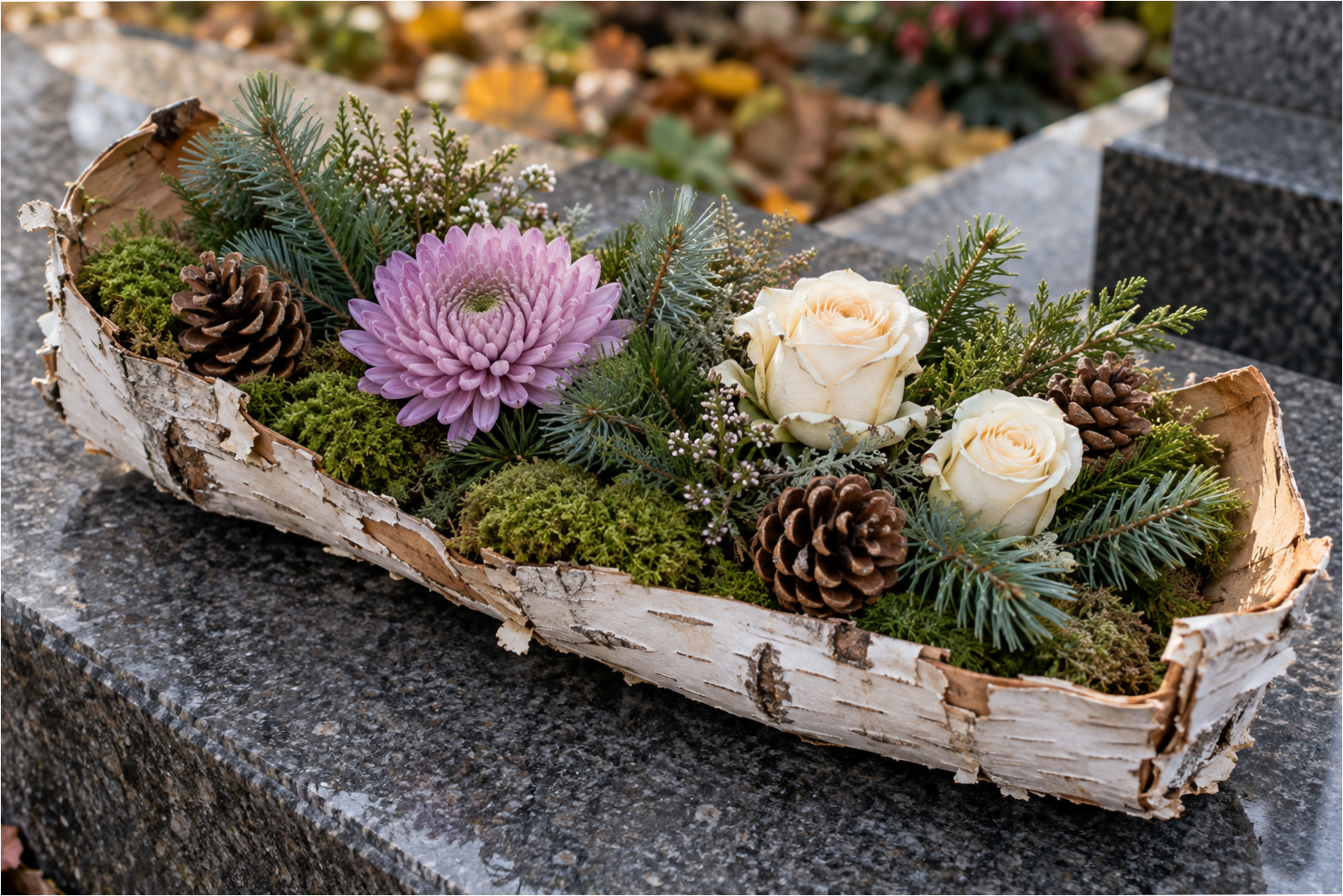
19. Creating a subtle toned version: Complement light apricot flowers with cones of various sizes. Direct the branches to the sides and upwards, and let the front edge be partly covered with moss. This way, the decoration won’t look flat.
20. Final balancing of the composition: The last example combines white flowers with dusty pink roses, cones, and small twigs. Before placing it on the grave, check the view from all sides, adjust protruding branches, and remove any loose parts that could be blown away by the wind.
Final Tip
Adapt the decoration to the shape of each piece of bark. Place taller elements toward the back or middle, and keep the front edge lower so the birch pattern remains visible. If you use fresh flowers, remember they won’t last as long and replace them later with dried plants or more cones as needed.